
Blog
Dental hygiene tips for healthy teeth & gums
How to Remove Plaque From Teeth: Effective Methods That Work
Most people find out they have plaque when a hygienist mentions it, which is a strange way to learn about something that’s been on your teeth since this morning.
How to remove plaque from teeth has a dull answer everyone already knows. The more useful question is why people who brush twice a day and floss most days still get told they have buildup at every checkup.
Two reasons, mostly. Where the brush goes matters more than how long it’s in your mouth. And there’s a hard line between what a toothbrush can shift and what it can’t, which nobody explains until a hygienist is already scraping.
TL;DR
How to remove plaque from teeth is mostly a question of reaching the parts you’re missing, and knowing when it’s too late for a brush to help.
The hardening starts fast. Plaque can be half mineralized within two days and most of the way there inside a fortnight.
Most people are fine on the outer surfaces and lose badly between the teeth. That’s two of the five surfaces on every tooth, and a brush reaches neither.
Scrapers and acidic home remedies do more damage than good. Enamel and gum tissue both suffer.
Tartar turning up at a checkup is ordinary. It’s what the appointment is for.
Why Does Plaque Come Back So Quickly
Rinsing does nothing to plaque, which surprises people. The bacteria build themselves a protective matrix and live inside it, anchored to the tooth, and only physical disruption breaks that apart.
Rebuilding starts as soon as you spit. Proteins from saliva coat the enamel within minutes, bacteria attach to that coating over the following hours, and by the end of a day there’s an established layer sitting there.
Sugar makes it worse in two directions. It feeds the colony, and the acid those bacteria produce is what dissolves enamel. Their waste is what inflames the gums.
Nobody eliminates plaque. Yours will be back tonight regardless of what you do this morning, and the job is disrupting it often enough that it never gets properly established.
Plaque vs Tartar – Where the Line Falls
Plaque vs tartar is a question of timing more than substance. It starts as the soft pale stuff that comes away on bristles. Left alone, it takes on calcium and phosphate from your saliva, crystallizes, and stops being removable.
The window is shorter than most people assume. A case report in the Journal of Indian Society of Periodontology puts calculus formation at one to fourteen days after plaque develops, reaching 60% to 90% of its calcification by day twelve.
After that, it’s bonded on. Brushing harder achieves nothing except wearing down the enamel around it.
Tartar then makes its own problem worse. Its surface is rough enough to hold the next layer of plaque, and the same paper notes it acts as a nidus for continued accumulation. The lower front teeth collect it fastest because a salivary duct opens right underneath them.
How to Remove Plaque From Teeth at Home
Most of how to remove plaque from teeth happens at the sink, and most of it is technique rather than effort.
Two minutes, timed. Almost everyone believes they brush for two minutes. Almost nobody does, and the gap is large enough that a timer settles the argument.
Bristles at 45 degrees into the gumline. The highest-value correction on this list. Plaque gathers in the crevice where tooth meets gum, and brushing flat across the face of a tooth polishes enamel while missing that entirely.
Something between the teeth, daily. Floss, interdental brushes, a water flosser, whichever you’ll actually use. Those two surfaces a brush can’t reach are where decay and gum disease start.
An electric brush, if you have one. Oscillating and sonic heads outperform manual brushing in most comparisons. The motion is handled for you, and all you supply is position.
Brush your tongue. It holds a large bacterial population that reseeds clean teeth within hours.
Rinse with water after eating. This does nothing to plaque. What it clears is sugar, which shortens the acid window.
Does Tartar Removal at Home Ever Work
Once it has hardened, no. Tartar removal at home is worth stating plainly, because search results are full of methods that sound reasonable and aren’t.
Scalers sold online do the most harm. Hygienists train for years on angulation and pressure alone. Get the angle wrong at home and the tip skids off the deposit, into whatever is next to it. Usually enamel. Sometimes gum.
Baking soda gets recommended constantly. It’s a mild abrasive, so it’ll shift surface stain and do nothing whatsoever to calcified deposits. Vinegar and lemon juice are worse ideas, because anything acidic enough to soften mineral is working on your enamel at the same time.
Tartar-control toothpaste is the one thing here with a real role. The pyrophosphates in it slow new mineralization down, so it does nothing to what’s already formed but buys you time between appointments. Useful if you’re someone who builds calculus quickly.
Buildup You Can’t Brush Away?
Book a cleaning and get your teeth back to a clean starting point.
What Happens During a Professional Cleaning
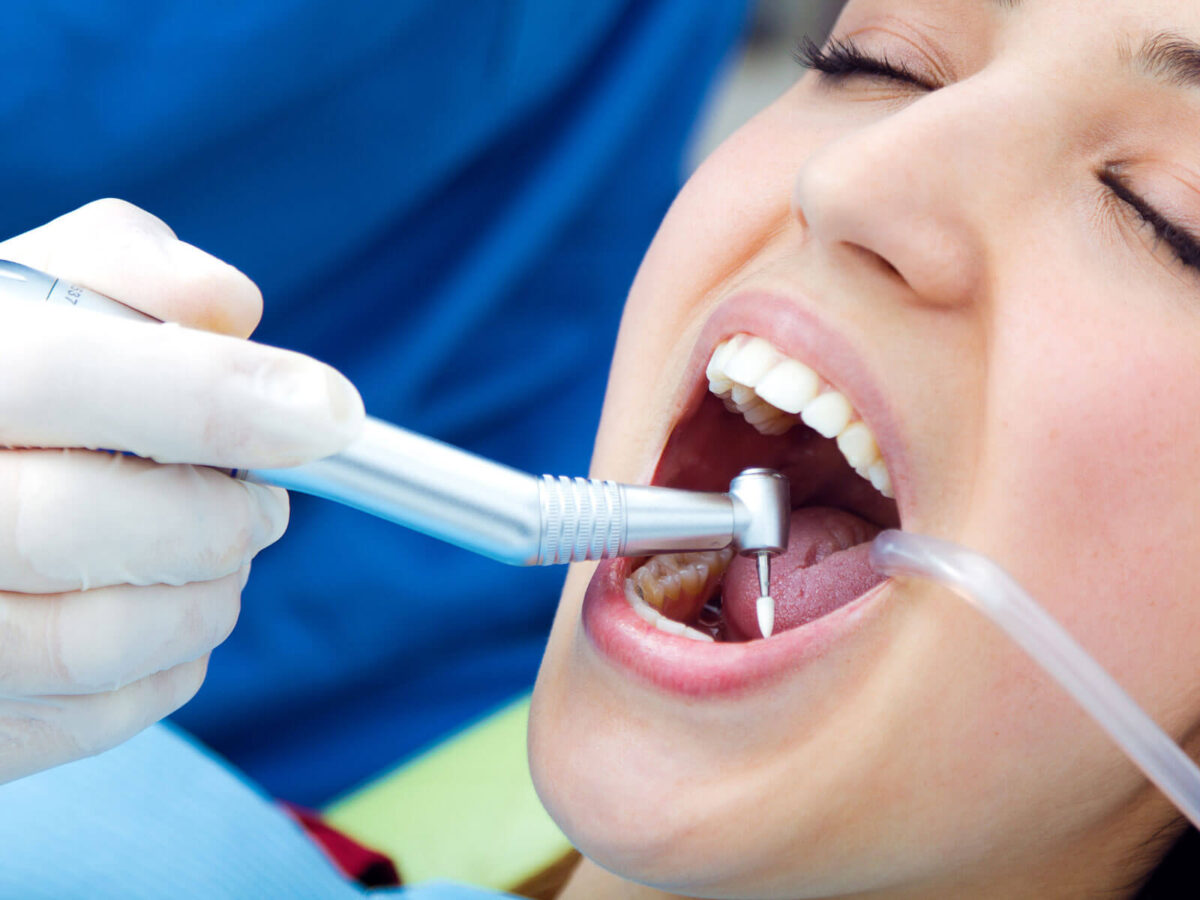
The ultrasonic scaler comes out first, and it’s the part people brace for. Vibration and a water spray knock the calcified deposits loose. Most find the noise harder to sit through than anything they actually feel.
Hand instruments follow, for whatever the ultrasonic tip couldn’t reach. That’s mostly just below the gumline, where subgingival deposits sit out of sight.
Polishing finishes it. A rotating cup and a mildly abrasive paste, which clears stain and leaves the surface smooth enough that plaque struggles to get a grip on it.
Then someone tells you which spots you keep missing. Nobody enjoys that part of the appointment, and it’s the part worth paying attention to.
Twice a year sounds like a lot until you see the numbers. A 2025 paper in the Journal of Clinical Periodontology describes calculus as reaching a prevalence as high as 90% in adults, making it the most common pathological calcification in the human body.
What’s the Professional Teeth Cleaning Cost
A routine hygienist appointment sits in the low hundreds of dollars at most private practices. Bundled with a check-up, it usually comes in lower.
Deep cleaning is a different service and priced accordingly. Scaling and root planing gets quoted per quadrant, generally involves local anesthetic, and often spans two visits.
Insurance treats the two separately. Most plans cover two routine cleanings a year at or near full cost. Deep cleaning tends to be covered at a lower percentage and usually needs your dentist to document what they’ve found first.
Dental schools and community clinics come in substantially cheaper. You’ll be there longer, since students work slowly and everything gets checked by a supervisor.
FAQ
Can plaque be removed without a dentist?
Soft plaque, yes. Tartar needs instruments you can’t buy.
How often do you actually need a cleaning?
Six months for most people. Heavy calculus formers and smokers usually get put on three or four, and so does anyone with gum disease in their history.
Is a water flosser as good as floss?
It depends where. Around braces and bridges, a water flosser is easier to use, and people stick with it. Floss still wins on tight contacts between teeth.
Why do my lower front teeth build up fastest?
A salivary duct opens right underneath them, so that stretch gets a constant supply of the minerals that harden plaque.
Conclusion
The division is clear once you can see it. Anything soft is your job, twice daily, with a brush and something that fits between teeth. Anything hard belongs to whoever owns the ultrasonic scaler.
How to remove plaque from teeth stops being a useful question the moment that plaque has hardened. By then it’s a hygienist’s job, and you usually find out at a checkup.
The spots you keep missing are worth knowing. Ask the hygienist next time, and most will show you, though it’s rarely a surprise once you hear it.
Get a Proper Clean and a Clear Plan
Book a professional cleaning and find out where your routine falls short.

